Each Chess Power Regional event has 7 rounds. Students compete individually, but schools can also qualify as teams.
How team scoring works
A school team must have a minimum of four players. You may have more than four players, but only the top 4 player scores in that team are added together to calculate the team score. There is no maximum number of players in a team.
In general, the top 3 teams at each Regional event qualify for Nationals.
When a school team qualifies for Nationals, the school receives 5 Nationals spots. If more than one team from the same school qualifies, the school receives one additional spot per qualifying team, up to a maximum of 8 spots.
There are usually two Regional events each year: one in Term 2 and one in Term 3. This gives schools more than one opportunity to qualify and earn Nationals places.
Recommended team strategy
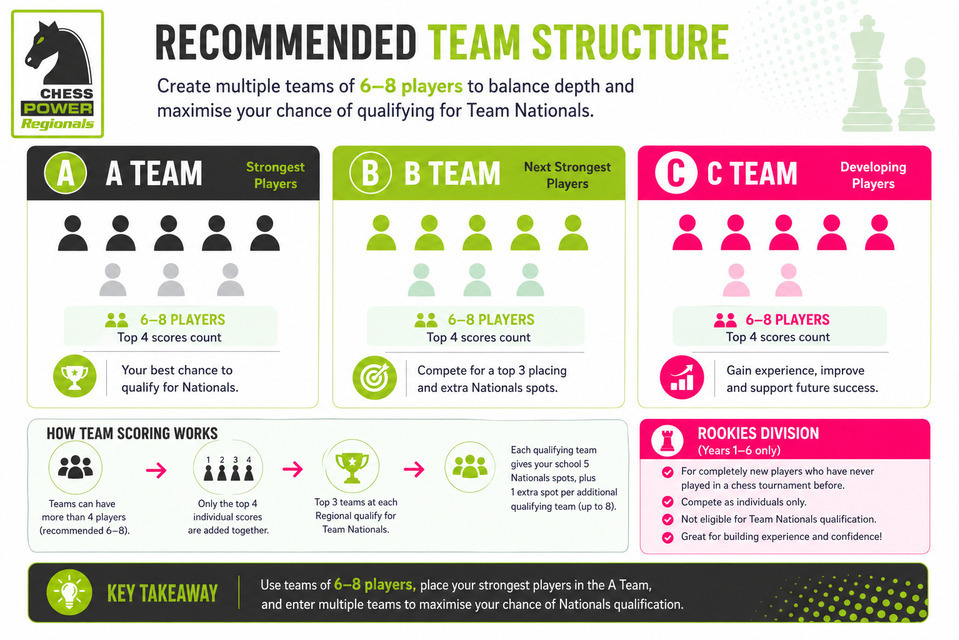
In general, the more teams a school enters, the more chances it has to qualify for Nationals and earn additional Nationals spots.
However, teams that are too small carry more risk. Since only the top 4 scores count, a team of exactly 4 players has no backup if one player has a difficult day or scores lower than expected.
For this reason, we recommend schools create teams of around 6–8 players where possible.
This gives each team:
- enough players to provide a safety buffer
- enough depth so the top 4 scores are still strong
- enough flexibility to enter multiple teams
For example, if a school has 20 players, a good structure would be:
Team A: 7 players
Team B: 7 players
Team C: 6 players
This gives the school three teams competing for qualification, while still giving each team backup players.
If you have 8 or less players entering an event, it is best to put them all in one team as splitting them will not give you any buffer should any players not play well on the day.
How to place players into teams
The strongest players should be placed in the A Team, because this team gives the school its best chance of qualifying for Nationals.
A simple structure is:
A Team: strongest players
B Team: next strongest players
C Team: developing or newer players
This approach gives the school the best chance of securing at least one Nationals qualification, while still allowing other teams to compete for additional qualification places.
What about the Rookies divison?
The Rookies Division is designed for:
- Years 1–6 students only
- players who are completely new to chess
- players who have never played in a chess tournament before
This division is focused on introduction and participation, and is priced lower to encourage early engagement.
Players in the Rookies Division compete as individuals only and:
* Do NOT contribute to team scores
* Are NOT eligible for Team Nationals qualification
As students play as individuals, there is no minimum or maximum number of players you can place in the Rookies division.
What this means for structuring teams
When planning your teams for Regionals:
- Do not include rookies in your team calculations
- Only include experienced players (non-rookies) when forming A, B, and C teams
- Treat the Rookies Division as a development pathway, not part of your competitive team structure
Recommended approach
- Enter new players into the Rookies Division to build confidence and experience
- Build your competitive teams from experienced players only
- Over time, move rookies into standard divisions once they are ready
This approach ensures:
- your competitive teams remain strong and eligible for qualification
- new players have a positive first tournament experience
- your school builds a sustainable pipeline of future competitive players
Key recommendation
For most schools, the ideal structure is:
- Teams of 6–8 players
- Strongest players in the A Team
- Rookies kept separate in the Rookies Division
This gives the best balance between:
- maximising qualification chances
- reducing risk within teams
- developing new players
- increasing overall participation